
There is a sentence that keeps circling me lately:
Capacity is a form of self-respect.
And friend, I think a whole lot of us need to hear that.
We were raised, trained, rewarded, and praised for doing the opposite.
Say yes.
Push through.
Figure it out.
Be flexible.
Be helpful.
Be the one who can carry more.
Until one day you look around and realize you are serving everyone but yourself.
We praise that kind of overextension like it’s noble, but all it really does is grind people down. You cannot be everything to everyone all the time. You just can’t.
Somewhere along the way, especially for people in human-helping professions, we started acting like work was the whole point of being alive. It’s not. We are not here just to work. We are not here just to serve. We are here to explore this life, too.
I keep coming back to capacity because it gives me useful information. It shows me what I can actually hold with integrity. And that feels like self-respect to me.
When You Ignore Capacity, Everything Gets Heavier
When I ignore my capacity, I do not become some one-woman efficiency machine.
I get scattered.
I get reactive.
I lose focus.
I get irritated.
I start trying to keep all the plates spinning in the air while adding another plate and another plate and another plate, hoping none of them crash.
I know this season well.
Right now, I’m in a stretch of writing proposal after proposal after proposal. It is exciting. It is abundant. It is also a lot. I’m grateful for the opportunities, and I still have to be honest that the volume of work behind the opportunity is real. With abundance comes responsibility. With growth comes follow-through. That means rhythm matters. Pace matters. Support matters.
If I try to hold it all in my head, forget it. I will miss things. I will stress myself out. I will waste energy trying to remember what I could have simply written down. Which is why one of the most respectful things I do for myself is give my brain less to carry.
My Capacity Looks Like a Notepad
I know there are all kinds of digital systems out there. God bless them. I know they work beautifully for some people.
But me?
I need a physical, handwritten list.
I have a notepad with 20 lines on it. Twenty. That’s it. Number 21 has to wait for the next page. I write the tasks down. I rewrite the list every day. I cross things off. I prioritize. I let some things marinate so I can respond instead of react. And when I cross something off? Oh, let me tell you…it feels soooo good.
That little practice gives me something priceless:
Freedom.
I believe within structure, there is freedom.
When I know what the priorities are, my shoulders relax. I’m not carrying phantom tasks in six tabs and four half-finished thoughts. I can actually be present with the thing in front of me. Then, if I finish early, I have space to review something, dream up a podcast episode, or sketch the next idea.
That doesn’t feel rigid to me. Trust me, I am deeply anti-rigidity. Like, “don’t try to put your girl in a box” anti-rigidity. I’ll shut that down real quick. Structural support holds up buildings, baby. That’s how powerful the right support can be.
Structure Doesn’t Ruin Creativity. It Protects It.
I think a lot of people assume structure is the enemy of inspiration.
Not for me.
For me, structure is what lets inspiration breathe.
If I have six meetings in a day, my creativity is toast. I know that now. I found that out the not-fun way. I cannot switch my brain six times, answer all the things, and then expect myself to sit down and create with soul. Absolutely not. My sweet spot is about three meetings a day, and if I can get it to two? Even better. That is structure by design. It is not me being difficult. It is me protecting the quality of my work and the quality of my life.
That’s what I want more women to understand:
Capacity is not weakness.
It is information.
If you know you need room to think, create, recover, and serve well, build your life with that in mind.
Build Conditions That Support Your Capacity
This is where I get a little woo, and if you’ve been around me longer than five minutes, you already knew that.
I set myself up to work well.
Phone on Do Not Disturb.
Instrumental music only.
Incense.
Plants.
Water.
Crystals.
Sunlight.
Open windows.
Grounding mat under my feet.
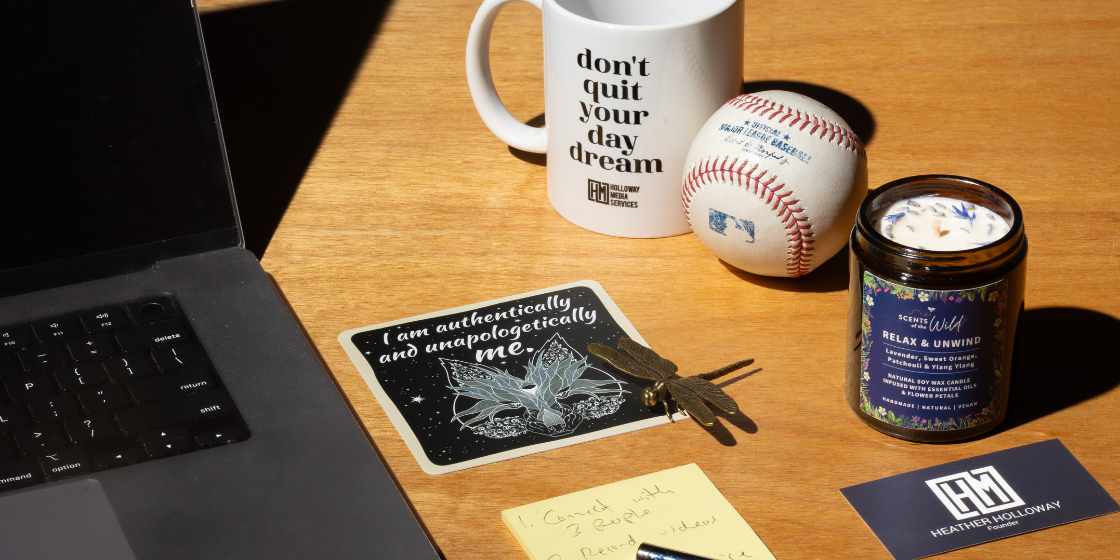
Little objects on my desk that make me smile or remind me what matters.
Why?
Because environment matters.
I don’t want to be pinged into oblivion and then wonder where my focus went. I don’t want lyrics interrupting my writing. I don’t want stale energy around me while I’m trying to create something meaningful. I want life around me. I want calm around me. I want things that tell my nervous system: we are safe, we are supported, we are allowed to create from a grounded place.
This wasn’t how I started my professional working career. I learned this over time.
There was a season where I was more like the cat meme — just sit down and slam into the desk and go. That was then, this is now. Today, I take a much more intentional approach.
The name of the game is intentional. What lights you up? What helps you breathe? What reminds you who you are? Start there. Put one thing on your desk that truly touches your heart, not surface-level cute, but genuinely supports you. Then build from there.
Nature Counts as Support
I also need to say this plainly:
I need to see the sky.
I need sunlight.
I need plants.
I need to get outside.
There was a time when I worked in a shared office space with four closed walls and no real connection to the outside world, and those walls felt heavy. Ever since I moved home and started working closer to windows, light, plants, and fresh air, something has shifted. I feel more alive. More inspired. More connected. More me.
Life begets life, baby.
If I care for the plants, I am reminded to care for myself.
If new shoots are coming up, maybe something in me is growing too.
If I can’t physically get outside, at least I can turn around and see my little green friends. And that helps. Happy people do better work. Happy people write better proposals. Happy people build stronger businesses.
What This Looks Like for You
You do not need my exact setup.
Your way may not be my way. My way is not the best way. I invite people to find their way.
But I do think the question matters:
What would it look like to respect your capacity enough to create the conditions for good work?
Maybe that means:
- blocking one hour of uninterrupted focus time
- putting your phone away while you finish one task
- limiting the number of meetings you say yes to in a day
- keeping a handwritten list instead of trying to mentally juggle everything
- putting something on your desk that lights you up
- taking five minutes to step outside before your next shift, meeting, or class
This month, don’t just ask, “How can I get more done?”
Ask:
“What would help me do this well without abandoning myself?”
That question will take you further.
This Month’s Challenge
Pick one way to support your capacity this month.
Just one.
One small structural choice.
One environmental shift.
One ritual.
One limit.
One supportive object.
One less thing in your head.
Try it for a week.
Notice:
- What changes in your shoulders?
- What changes in your mood?
- What changes in your focus?
- What changes in the quality of your work?
Good work comes from support. From clarity. From honoring your humanity while you serve.
I don’t see that as indulgent. I see it as wisdom, especially for people whose work asks so much of them.
You are allowed to build a life and a work rhythm around it.
You’ve got this.
If this stirred something up in you and you’re thinking, “Okay, Heather, I know I need this, but I don’t know where to start,” that’s exactly the kind of conversation I love having. My Stress Less, Serve More message is built for people who give a lot, care deeply, and want a steadier, more sustainable way to work and live.
Let’s chat!